

How to Create a Cybersecurity Policy for Small Businesses (With Template)

- Cybersecurity
- May 29, 2026
Cybersecurity for small businesses is no longer optional; it is operational.
Small businesses store client information, financial records, employee data, and access credentials every day. A single misconfiguration or phishing click can expose more than just files. It can damage trust, interrupt operations, and create legal consequences.
Many owners invest in antivirus software or multi-factor authentication. Fewer take the time to document how security should actually work inside their organization. And that is where a cybersecurity policy becomes essential.
Our cybersecurity guide explains what cybersecurity for small businesses should include and provides a clear cybersecurity policy you can adapt for your team.
Why Cybersecurity for Small Businesses Requires a Written Policy
A cybersecurity policy is not just paperwork. It sets clear expectations for how your organization protects data and systems. Without that documentation in place, employees make inconsistent decisions, security practices vary from one department to another, and leadership may assume protections exist when they do not.
Cybersecurity policies are so critical for businesses of all sizes that federal agencies actively encourage formal documentation. The Federal Trade Commission recommends that small businesses implement written security programs and clearly defined procedures to reduce risk and improve accountability. Similarly, the Cybersecurity and Infrastructure Security Agency provides guidance specifically tailored to small and medium organizations.
A written policy ensures that cybersecurity for small businesses is proactive rather than reactive.
What a Cybersecurity Policy for Your Small Business Should Include
Every small business operates differently. The way a retail company handles data will not look the same as a law firm or a nonprofit organization. That is why cybersecurity policies should be tailored to your specific systems, risks, and workflows.
The framework below outlines a practical starting point. Think of it as a cybersecurity policy for a small business template that helps you structure your thinking. From there, working with an experienced IT provider like DeepTech ensures your policy reflects your real environment, compliance requirements, and long-term growth plans.
1. Purpose and Scope
Every cybersecurity policy should begin by clearly defining its purpose and boundaries. This section explains what the policy is designed to protect, who it applies to, and how it supports your organization’s overall security standards. Define:
- What systems are covered
- Who the policy applies to
- Why cybersecurity matters to your organization
Example language:
“This policy outlines how our organization protects sensitive data, systems, and client information. It applies to all employees, contractors, and third-party vendors with access to company resources.”
Keep it simple. The goal is alignment and clarity.
2. Access Control Standards
Access management is one of the most important aspects of cybersecurity for small businesses. Your cybersecurity policy should document:
- Who approves new accounts
- Role-based permissions
- Offboarding procedures
- Password requirements
- Multi-factor authentication enforcement
If you have already implemented multi-factor authentication, your policy should reflect it. Many small businesses enable MFA but never formally require it in writing. That gap creates inconsistency. If you have not set up MFA yet, this is a foundational step.
3. Device and Remote Work Security
Small businesses often operate in hybrid or remote environments. Ensure your cybersecurity policy addresses:
- Company-owned vs personal devices
- Minimum security requirements
- Antivirus and endpoint protection standards
- Secure Wi-Fi usage
- VPN or secure access protocols
The National Institute of Standards and Technology provides practical security guidance that small businesses can adapt. Your policy does not need to mirror enterprise frameworks; it needs to define reasonable expectations.
4. Data Protection and Backup Procedures
Imagine arriving Monday morning, and your accounting system will not open. A staff member clicked on a malicious attachment on Friday afternoon. Files are encrypted. Donor records, payroll data, contracts, everything is inaccessible.
You call your IT contact and ask, “We have backups, right?” Silence.
Cybersecurity for small businesses must include data continuity planning. Backups are not just about having copies. They are about being able to restore operations quickly and confidently.
Your policy should outline:
- What data is considered sensitive
- Where it is stored
- Backup frequency
- Backup testing procedures
- Retention timelines
Many small businesses believe backups are running simply because no alerts have appeared. The real test is restoration. If you cannot verify that your data can be recovered, you do not have a backup strategy; you have an assumption. Documentation forces accountability.
5. Email and Phishing Prevention
Email is still the easiest way into a small business. One convincing message that looks like it came from a vendor, a bank, or even your own team can trigger a wire transfer, expose credentials, or install malware in seconds. That is why your cybersecurity policy should clearly define:
- Phishing awareness expectations
- Reporting procedures for suspicious emails
- Rules around financial transfer requests
- External email warnings
If your team has already reviewed how to identify suspicious emails and reduce phishing risk, that guidance should be formalized within your written policy.
6. Incident Response Plan
Every cybersecurity policy should define what happens when something goes wrong.
Imagine a staff member reports unusual login activity or a client calls asking why they received a strange email from your domain. In those moments, hesitation creates risk, unclear roles create confusion, and silence creates liability.
For these reasons, make sure your policy clearly outlines:
- Who to contact internally
- Who handles technical investigation
- How incidents are documented
- Communication expectations
- Regulatory reporting requirements, if applicable
The U.S. Small Business Administration provides guidance on incident response planning for small businesses. An incident response plan does not prevent incidents. It prevents chaos when they happen.
7. Vendor and Third-Party Risk
Your security is only as strong as the vendors you trust. Small businesses depend on cloud platforms, SaaS tools, payroll providers, accounting systems, marketing software, and outside consultants to operate efficiently. Each one of those partners has access to some part of your data, systems, or workflows. If their security practices fall short, your business absorbs the impact.
Your cybersecurity for small businesses policy should clarify:
- How vendors are evaluated
- What security standards are required
- How access is granted and revoked
- Contractual data protection expectations
Common Mistakes Small Businesses Make
Cybersecurity for small businesses should be practical, readable, and aligned with how your team actually works. When drafting a cybersecurity policy, avoid:
- Writing overly technical language employees will ignore
- Copying enterprise templates that do not reflect your operations
- Failing to update the policy annually
- Creating documentation without enforcement
How Often Should You Review Your Cybersecurity Policy?
A cybersecurity policy should not sit in a shared drive untouched for years. It should evolve as your business evolves. At a minimum, review your policy:
- Annually
- After major system changes
- After security incidents
- When adopting new technologies
As more small businesses integrate AI tools, cloud platforms, and automation into daily operations, governance becomes more important. Policies should grow alongside your systems.
It is always a good idea to involve a cybersecurity partner like DeepTech during these reviews. An outside perspective helps identify blind spots, validate controls, and ensure your documentation matches how your technology is actually configured.
Download a Cybersecurity Policy for Small Business Template
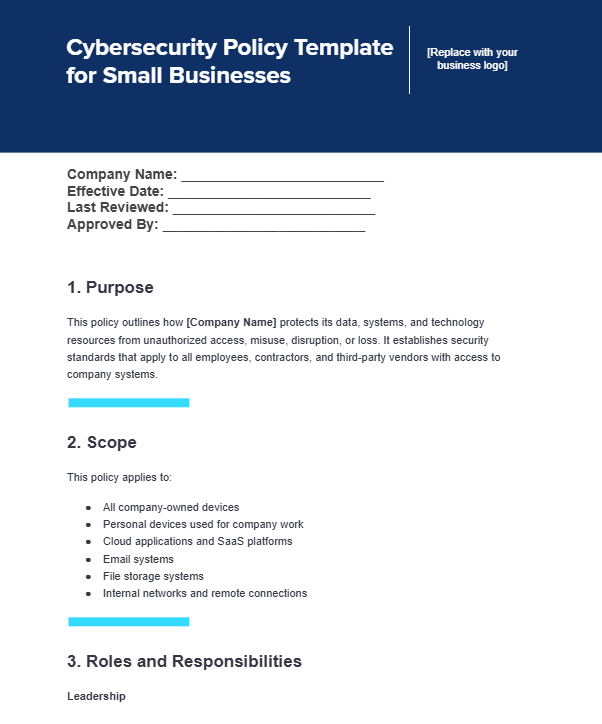
Creating a cybersecurity policy can feel overwhelming when you are starting from a blank page. To make the process more manageable, we have developed a cybersecurity policy for small businesses template designed to help you organize your security standards clearly and practically.
It is built to give small business owners a solid framework that can be customized to their operations. This template includes structured sections for:
- Access control
- Data protection and backups
- Vendor management
- Incident response
- Remote work security
Review it with your leadership team, and use it as a foundation for strengthening cybersecurity for small businesses inside your organization.
If you would like guidance on tailoring the template to your systems, compliance requirements, or industry risks, DeepTech can help you refine and implement it with confidence.
Strengthen Your Small Business Security Framework With Confidence
Creating a cybersecurity policy shows leadership. It demonstrates responsibility to clients, employees, and partners.
If your team is building a policy and needs a second set of eyes to review gaps, validate configurations, or align documentation with real-world systems, DeepTech supports small businesses across New York and California with practical cybersecurity strategy and managed IT oversight.
Security should not feel overwhelming. It should feel structured, manageable, and aligned with your operations. Start with a framework and build from there.
Turn your cybersecurity policy into a working security program with the right managed IT support.